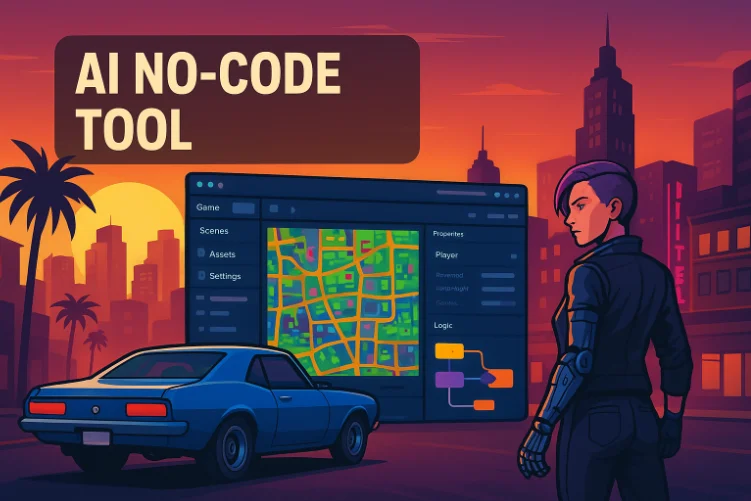
The Grand Theft Auto series is a titan of the gaming world. Its sprawling cities, chaotic freedom, and gripping stories have captivated millions. For many aspiring developers, creating a game with that level of scale and complexity feels like an impossible dream, reserved only for AAA studios with huge teams and nine-figure budgets.
What if that wasn’t true? What if you could build your own vibrant, explorable GTA-style open-world game without writing a single line of code? This isn’t a far-off fantasy anymore. Thanks to the rise of AI game creation and no-code game development tools, the power to build vast, interactive worlds is now in your hands.
The guide will show you how to take that idea for an open-world game and turn it into a reality. We will break down the core mechanics that make these games so compelling and walk you through a step-by-step process to build your own, all by leveraging the power of AI and intuitive, visual editors by Astrocade. It’s time to stop dreaming and start building.
What Makes a Game “GTA-Style”?
When we talk about making a game like “GTA,” we are not talking about copying its story, characters, or specific assets. That’s a direct path to creative and legal trouble. Instead, we’re focusing on borrowing and reinterpreting the core open-world game mechanics that define the genre. As we have covered in our guide on how to legally clone a game, mechanics are the building blocks of gameplay, and they are fair game for any creator. You can check Grand Theft Astro, the completely same game created using AI game creation tool astrocade.
So, what are the essential ingredients of a GTA-style open-world game?
- Open-World Exploration: At the heart of it all is a large, seamless map that players can explore freely. This environment is more than just a backdrop; it’s a sandbox filled with potential for emergent gameplay and discovery.
- Vehicle System: The ability to find, steal, and drive a wide variety of vehicles is a hallmark of the genre. Cars, motorcycles, boats, and even planes give players the tools to traverse the large world quickly and cause a bit of chaos along the way.
- Mission Structure: A compelling game needs direction. This comes from a mix of story-driven main quests that advance a central narrative and a variety of side activities, like races, deliveries, or mini-games, that flesh out the world and offer rewards.
- Player Agency & “Wanted” System: Players have the freedom to do what they want, but that freedom comes with consequences. A “wanted” system or a similar mechanic reacts to the player’s actions, sending law enforcement or other factions to respond to their behavior. This creates a dynamic relationship between the player and the world.
- Third-Person Character Control: The camera follows the player character from behind, giving a clear view of both the character and their immediate surroundings. This perspective is ideal for the mix of on-foot exploration, shooting, and driving that these games are known for.
By understanding these five pillars, you can start to see how a complex game is really just a collection of interconnected systems. With a no-code tool, you can build these systems one by one without needing to be a programming expert.
How to Build Your Open-World Game in 5 Steps with AI
Feeling inspired? Let’s get practical. Here is a five-step guide to building the foundations of your very own GTA-style open-world game using an AI game creation platform.
Step 1: Define Your Unique Vision
First things first: your game shouldn’t be a simple copy of GTA’s modern-day urban setting. The beauty of AI game generation is that you can bring any theme to life. Take the core mechanics we just discussed and apply them to a world that’s uniquely yours.
Spend some time brainstorming. Instead of Los Santos, maybe your world is:
- A neon-drenched cyberpunk metropolis where players hack drones instead of hotwiring cars.
- A sprawling fantasy kingdom where you ride griffins instead of motorcycles.
- A post-apocalyptic wasteland where you build and defend makeshift vehicles.
- A comical cartoon city where the “wanted” system involves getting chased by angry bakers wielding rolling pins.
Your theme will guide every asset you create, from the environment to the characters and vehicles. A strong, unique vision is what will make your game stand out.
Step 2: Generate Your World with AI
With your theme decided, it’s time to build the sandbox. This is where AI asset generation truly shines. Forget spending months modeling every building and blade of grass. You can generate a vast, explorable map using simple text prompts.
In your no-code tool, you might use a prompt like:
“top-down map of a dense, neon-lit cyberpunk city at night, with towering skyscrapers, narrow alleyways, and glowing advertisements”
The AI can then generate a 2D map layout. From there, you can use other prompts to create the 3D assets that will populate your world. For example:
“futuristic skyscraper with holographic billboards”
“grimy back-alley street vendor stall selling noodles”
By repeatedly using prompts guided by your theme, you can quickly generate a library of unique buildings, roads, foliage, and props. A visual editor then allows you to place these assets onto your map, crafting your world block by block, but without the manual labor of creating each asset from scratch.
Step 3: Create Your AI-Powered Characters and Vehicles
Your world needs inhabitants and ways to get around. Using the same AI-powered tools, you can design your player character, non-player characters (NPCs), and vehicles.
Use descriptive prompts to define their appearance and style:
- For a character: “player character, female cyborg street samurai with a robotic arm and a leather jacket, cyberpunk style”
- For a vehicle: “hover car, sleek and futuristic with glowing blue underlights, looks fast and agile”
You can generate entire fleets of vehicles and a diverse population of NPCs to make your world feel alive. This process allows you to maintain a consistent art style across all your assets, ensuring your unique vision remains coherent.
Step 4: Implement Game Mechanics with a No-Code Editor
Now that you have your world and your assets, it’s time to make it all interactive. This is where the no-code game development editor comes into play. Instead of writing code, you’ll use a visual, logic-based system to implement the open-world game mechanics.
Here’s how you might set up the core systems:
- Player Control: Drag and drop a pre-built third-person controller onto your character model. Tweak settings for movement speed and jump height.
- Vehicle System: Create logic that says, “When the player presses ‘F’ near a car, hide the player model and give them control of the car.” This is often done by connecting nodes in a visual scripting graph.
- Wanted System: Set up a simple variable called WantedLevel. Create a rule: “If WantedLevel is greater than 0, spawn police NPCs and tell them to chase the player.” Another rule could be, “If the player commits a crime, increase WantedLevel by 1.”
These complex systems are broken down into simple, cause-and-effect rules that anyone can understand and implement.
Step 5: Design Your First Mission
Your world is explorable, but now it needs purpose. Let’s design a simple mission to get started. A classic GTA-style mission is the “fetch quest.”
Using the no-code tool, you can set this up visually:
- Create a trigger: Place an invisible trigger volume at “Point A” on your map.
- Assign an objective: Create logic that says, “When the player enters this trigger, display the objective: ‘Go to the warehouse at Point B to pick up the package.'”
- Place the destination: Put another trigger at “Point B” and link the package item to it.
- Set the completion condition: Create a final rule: “When the player enters the trigger at Point B, mark the mission as complete and give them a reward.”
You’ve just created a fully functional mission without a single line of code. From here, you can build more complex quests with branching paths, timers, and combat encounters.
Your Game, Your Rules
Creating a GTA-style or Minecraft type 99 Nights game, generating open-world games is no longer a task reserved for massive studios. By following these steps, you can see how this monumental undertaking becomes a series of manageable, creative tasks. The key is to start small. Build your world, implement one core mechanic at a time, and design a single, simple mission.
The power of AI game creation is that it handles the heavy lifting of asset creation, freeing you up to focus on what makes your game fun: the design, the story, and the unique rules of your world. Your game doesn’t need to be as big as GTA on day one. It can grow and evolve over time, with each new idea you have.
Ready to Build Your Saga?
We’ve deconstructed the mechanics of a complex genre and laid out a clear path for building your own version from the ground up. Combining the core principles of open-world game mechanics with the revolutionary power of AI asset generation and no-code game development has shattered the old barriers to entry. Your imagination is now the only limit.
Ready to build your own open-world saga? Try [AI Game Creation Tool Name] today and bring your vision to life!